MACERIE
UNIVERSITA' CATTOLICA MILANO
10.03 - 10.04.2026
The project presents a series of works dedicated to the theme of rubble, understood not only as the physical ruins left behind by conflict, but also as the inner fractures that scar bodies, imaginations, symbols, and identities.
The series explores post-traumatic stress disorder (PTSD) not merely as a recognized clinical phenomenon, but as a human condition that transcends eras, roles, cultures, and societies.
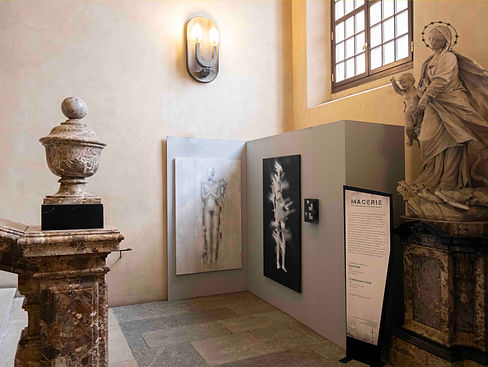
ARCHETYPES OF TRAUMA
The Prophet Ezekiel and the Migrant embody two different ways of navigating and transforming trauma. Both represent symbolic bodies that bear the traces of collective experiences.
Ezekiel is considered the first migrant prophet in history. He experiences war, exile, deportation to Babylon, and the destruction of his world, and his sacred visions are inevitably imbued with fear, violence, and the memory of those who experienced trauma.
Ezekiel describes divine visions as circles full of eyes, war machines moving in every direction, wings flapping at the roar of armies.
The trauma of war and the rubble transform into mystical visions: blurred figures, war chariot wheels, composite forms, and metallic light evoke the moment when the inner fracture generates a new sacred and symbolic language.
TESTIMONY
The Witness represents a body in constant motion, marked by physical and mental displacements.
Trauma manifests as a loss of orientation and a continuous reconstruction of meaning.
The body is dematerialized through a filter recreated in paint, based on an analysis of dozens of satellite photos of refugee camps. Here, lived experience is transformed into an emotional cartography, where the body becomes territory.


EZEKIEL
Ezekiel emerges as a figure in whom trauma is transformed into symbolic language.
In the painting, elements such as wheels, eyes, and composite structures allude to the visions of God described in his sacred text. The trauma does not disappear; it is reorganized into a system of meaning befitting prophecy.
The prophet is depicted using silver-based photographs, such as those used in the archaeology departments of Egyptian museums to document mummies and sacred funerary objects.
TRANSFORMATION
It is significant to observe how visual representations can emerge from traumatic experiences that transcend their specific contexts of origin.
Reinterpreting these images today—including as a counter-narrative to the events that were lived through and passed down—allows us to open up new levels of interpretation and redefine the relationship between experience, memory, and representation.


E. HUSSERL
“The mere sciences of facts produce mere men of fact […] In the misery of our lives, this science has nothing to say to us.
It excludes, as a matter of principle, those problems that are most pressing for human beings, who, in these troubled times, feel at the mercy of fate; the problems of the meaning and meaninglessness of human existence as a whole.”