ORME SULLA SABBIA
GALLERIA EX PESCHERIA CESENA
28.03 - 3.05.2026
Can the Subaltern Speak? “No” is the implicit answer given by the author of the essay titled after this question. Drawing inspiration from Gayatri Chakravorty Spivak’s reflections on the silence of the subaltern, *Footprints in the Sand* explores the dynamics of power and invisibility that characterize people with migrant backgrounds in Italy.
The project explores how the socio-economic and political system often fails to create the conditions necessary for listening, leaving those who work in key sectors—from agriculture to the restaurant industry—on the margins of visual and social perception.
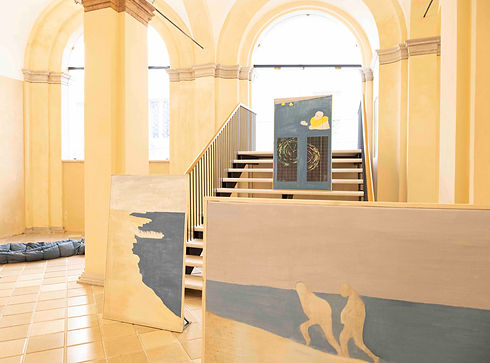
Through a practice that transforms testimony into landscape, the works convey the complexity of those who inhabit the margins. The series of works explores the new iconographies of migrant labor on the beaches, from invisibility to the imagery of bodies covered in merchandise to the reality of survival.
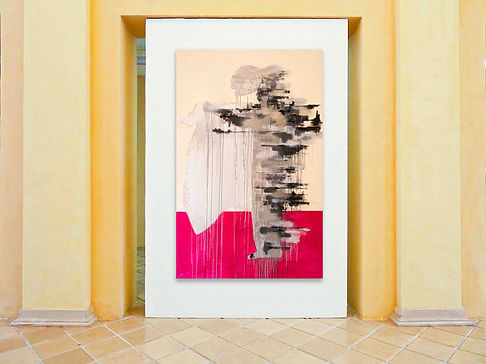
The workers’ bodies are painted through ‘filters’ of erasure that symbolize the various ways in which these people feel unseen, transformed by the logic of seaside capitalism into images, or commodities among commodities, obscured by the hurried gaze of money.
Bianca Basile

WESTERN FEAR
The series draws inspiration from images and videos created by the migrants themselves during their arrivals in the countries where they disembarked: footage taken from boats, at borders, and during
crossings.
Video frames originally created as tools of testimony and survival for families are isolated, enlarged, and translated into large-format paintings, transforming the language of urgency into a slow and reflective pace.
NEW ICONS
The works interrogate the various visual forms through which social anxiety regarding migration is produced.
Narratives of “invasion,” “danger,” and “Islamization,” now amplified by the growing use of generative artificial intelligence, which creates scenes that never happened and often become propaganda.

GHOSTED
Four large-scale paintings that explore new iconographies, aesthetics, and symbols associated with migrant labor on Italian beaches.
The works draw on the pastel tones of the Romagna Riviera, evoking an imagery of lightness, rest, and consumption. Within this aesthetic, bodies and figures marked by labor are inserted—laden with goods, hidden by the objects they sell, and obscured by blurring filters.
The works are based on interviews with beach vendors conducted by the artist.
LANDING
The works present images that blend tragedy and great hope, in which the depiction of the arriving migrants becomes a distillation of multiple and conflicting emotions.
The paintings convey a powerful vitality, while simultaneously framing it within the dismay of the local gaze, captured at the moment of encounter and confrontation with the arrival.

CAPITALISM AS A FILTER
Various filters of erasure and invisibility are applied to the bodies.
These are different ways in which street vendors feel unnoticed and unseen. Gathered from interviews, these perceptions have been transformed by the artist into four filters applied to the bodies, masking their identity and their distinctiveness.
The submersion of bodies by merchandise becomes a form of symbolic erasure, in which invisibility stems not only from racism but also from the logic of seaside capitalism and the haste of the beachgoer, who transforms people into images, categories, and commodities among commodities.
BEACH DRAWING
This drawings on paper offers an intimate reinterpretation of the traditional seaside sunset. These are not sunsets viewed from the comfort of the shore, but peripheral sunsets, seen from the perspective of street vendors at the end of their workday.
From the warehouses where goods are stored, from hidden storage areas, from the twilight of the pine groves, and from the distant dunes where the tents in which the street vendors sleep are pitched.
A visual fragment captured in the midst of exhaustion, at the heart of a workday, seized not from the threshold of leisure, but from the margins.


BIOPOWER
Among the various filters that permeate the works:
1) The concept of erasure, inspired by the containment mechanisms of European borders: barbed wire, walls, and biometric control systems.
2) The data filter, which evokes the bureaucratic and administrative dimension of migrant existence: forms, numbers, codes, certificates. A visual narrative that captures the complexity of a system in which identity is fragmented and reconstructed through procedures, practices, and documents.
3) The light filter introduces an almost spiritual and suspended dimension: street vendors appear as contemporary monastic figures, bodies on the move laden with objects that become signs, icons, relics.
AUDIO
The 45' audio features a series of quotations and excerpts from G. Agamben’s *Homo Sacer*, a seminal text on contemporary biopolitics that analyzes the figure of the marginalized individual and the current forms of bodily control exercised by those in power.
These voices intertwine with interviews collected by the artist—concrete testimonies of experiences of control endured and recounted by street vendors.
Alongside these references, the audio also includes testimonies regarding the strategies migrants themselves employ to evade the gaze of power: techniques of invisibility, identity protection, and micro-gestures of escape that allow them to exist on the margins of the system.
Additionally, there are reflections and comments taken from Reddit, where users discuss ‘Decoloniality Today,’ the strategies Italy should adopt to manage immigration, and self-proclaimed proposals for simple solutions to an extremely complex issue.


BOOK
About Fear, a book that explores the perception of immigration fear in Italy.
Racist AI-generated images, altered narratives, alleged Islamist conspiracies, and a very specific aesthetic of fear.