CONTRIBUTIONS TO SURVIVAL (From The Event)
HELMUT SPACE, LEIPZIG
06.02 - 20.03.2026
This exhibition is conceived as a geopolitical and iconographic study of the history of protests in Leipzig, with particular attention to the anti-LEGIDA demonstrations (an offshoot of the Pegida movement, Patriotic Europeans Against the Islamization of the West) in 2015.
The title of the exhibition refers to Martin Heidegger’s Contributions to Philosophy (From the Event), (1936-38), a text written during one of the most dramatic moments in European history, and published posthumously at the author’s request on the centenary of his birth in 1989. The same date coincides with the Leipzig protests of 1989.
In Contributions to Philosophy, Heidegger addresses some of the central themes of his thought: the relationship between subject and being, the question of the oblivion of being in modernity, and the possibility of an ontological “escape” from the historical dramas of his time. Faced with the crisis of traditional philosophical language and the inability of rational categories to respond to the violence of history, Heidegger directs his thinking towards a more poetic, fragmentary, and almost artistic writing, seeking in the ‘Event’ a new possibility of access to being.
Re-read today, in a context marked by geopolitical instability, crisis, and new forms of control and disinformation, Contributions to Philosophy resonates with an almost prophetic force. The tension between silence and speech, between Event and History, between escape and responsibility, becomes a lens through which to question the present and its images, opening up a reflection on the role of art in times of crisis.

ATLAS
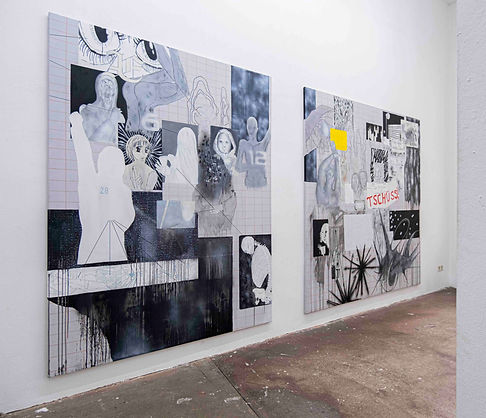
Atlas is where the multiple connections between images are explored, starting with archival photographs of the anti- Legida protests of 2015. The images are considered as nodes in a network of visual, symbolic, and emotional references.
Aby Warburg, a German art historian, developed this methodology in Bilderatlas Mnemosyne (1924). The Atlas, dedicated to cultural memory, consists of a series of plates composed of montages of heterogeneous images, through which Warburg reveals the mechanisms of transmission, survival, and transformation of themes and figures from antiquity—Western, Eastern, and Greco-Roman—to modernity.
PATHOSFORMELN
The second section, consisting of two paintings, explores another concept developed by A. Warburg, namely Pathosformeln.
Pathosformeln is the expressive formula of pathos, an extreme, vital gesture that a subject in an image performs almost instinctively, synthesizing an intense emotion that oscillates between the Apollonian and the Dionysian.
It is an iconic, spontaneous gesture so powerful that it transmigrates through time and maintains the same gesture over time, but perhaps changing form.
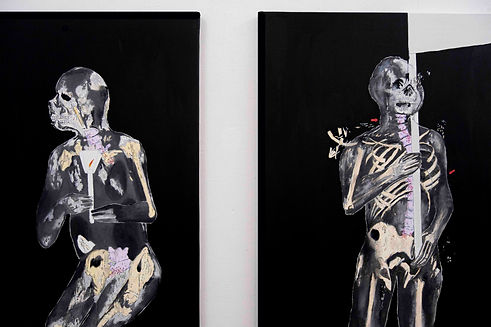
ICONOGRAPHY STUDIES N 1, N 2
Two works that seek to trace the themes, or common modes, in other past protests in Lispia: candle bearers, silent night assemblies, defensive gestures, bodies exposed in public space.
Protest as a silent ritual, the non-violent dimension, the battle against darkness, the incessant rain. How banners are transformed into candles, how the youth component remains, how new shared symbols appear.
MARGINAL NOTES
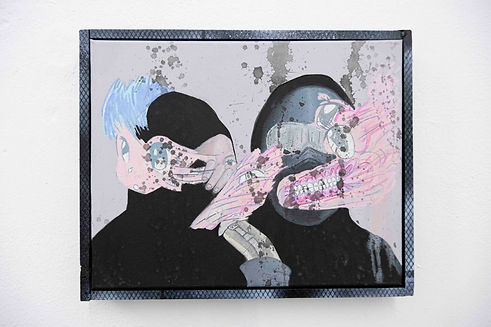
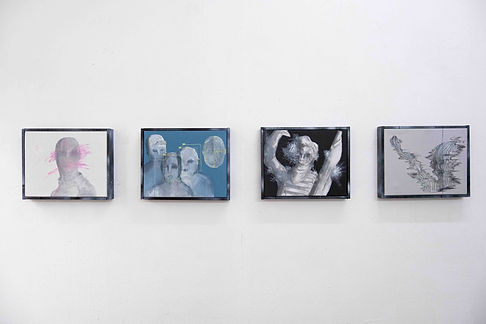
Five small-format works, explores the concept of the filter as a critical device. It is conceived as a lateral exploration, a series of marginal notes accompanying the most recognizable images of protest, offering secondary points of view that are less obvious but fundamental to understanding the complexity of protest phenomena.
These works analyze the ways in which protests are constructed, interpreted, and distorted. Through the use of filters, the section questions the idea of a neutral image of protest, constantly mediated by political, technological, and narrative apparatuses.

NEW PATTERNS
The panels are constructed by bringing together iconic images, without textual commentary, to investigate the formal persistence of gestures, postures, and iconographic patterns. In this way, Warburg shows how certain images continue to “live” over time, reemerging in different historical and cultural contexts.
The Atlas raises a series of questions: how many themes can be derived from a single image? How do images convey cultural memory, making leaps between past and present? How does the ancient continue to act in the present? Is there a continuity—or an unresolved tension—between rationality and impulse, between control and emotional energy?
POMPEII NOW
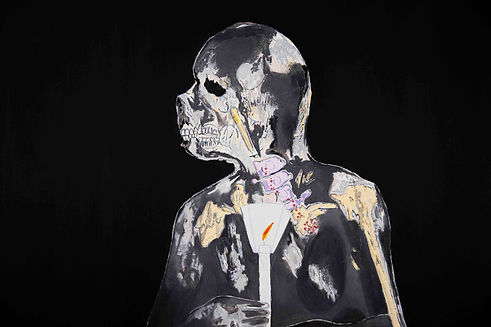
Two figures with iconic gestures, originating from protest contexts, are subjected to a visual treatment reminiscent of medical-archaeological CT scans used to study the bodies of victims of the eruption of Pompeii.
Borrowing an iconic gesture from a protester at the 1989 Leipzig protests and a protester at the 2015 anti-LEGIDA demonstrations, these figures take on a trans-historical dimension. The archaeological method creates a temporal short circuit: what is being analyzed is not a corpse, but a living political subject, exposed, scanned, and made legible.
The victims of Pompeii become a metaphor for protesters of all times: individuals who have risked their identity, privacy, and safety. Suspended between preservation and disappearance, they become permanently relevant bodies-witnesses, often fighting battles they cannot win, and are subsequently ‘used’ and ‘studied’ by others after them, for the same struggles, or for other struggles.

TRACKING
Dissolution
Political anger is shown here as a breakup of identity and form. The image of the violent protester—a common sight in the media—is broken down, showing how too much fighting can take away the meaning of the struggle, making the protest just about being against something.
Overlay
The ambiguous role of intelligence services and information apparatus in coordinating and controlling demonstrations. Through the superimposition of opaque pictorial layers, the blurred boundary between spontaneous dissent and strategic management of protest emerges, challenging the idea of mobilization as an exclusive expression of the will of the people.
AUDIO / A LIFELONG COWARD
A sound work intertwines fragments from Sophocles' Antigone with contemporary interviews to themes of everyday acts of courage, and discussions on Reddit about fear and being brave.
Antigone embodies one of the first figures to oppose Natural Law to the Law of the State. Her act of burying her traitorous brother, is an act of responsibility toward a more ancient and universal law. Antigone asserts her right not to obey tyrant Creon's law, and can be read as one of the tragic formulations of what we call Human Rights.